Always Be Writing
 “Always be writing,” my agent told me when we had our first phone call. I already knew this. Of course, I knew this. I’ve been a writer my whole life. Writing is the only way I know how to be.
But the way he said it reminded me of that line from the 1992 film Glengarry Glen Ross when Alec Baldwin scolds a group of realtors—“Always be closing.” Realtors don’t make money unless they close and writers aren’t writers unless they write—and, if we want to publish our work, finish what we write.
So let me tell you what it’s like to finish a novel and send it off—and then start writing something new. The first question, for me, is whether to write long or short. I have a few stories in the works, pieces I’ve started and finished and put aside. My latest short story will appear in the Saturday Evening Post in the fall. There are others I could go back to developing further. There’s a lot to say about the satisfaction of finishing something.
But I’m a fan of novels. I’m never not reading one—and so that’s the length I’m most drawn to. I always have a few ideas in the back of my mind vying for attention. I like to play around with one and then another, writing a few pages here, a few there, until one of them takes off and seems to be the one that has chosen me.
Whether long or short, working on something new opens all kinds of paths we might not be ready for. I’m not someone who outlines first. (Are you a pantser, plotter, or plantser?) I write, getting out all the words I can think of in a dreadful first draft. I free associate, letting the story go in whatever direction it wants. It might be raw, ugly, rushed. Nothing matters but to keep going.
And then I go back into those pages to see what’s there. Does any part of it work? Sometimes if I’m lucky I find a few gems. A plot twist, a character’s voice. Something that has heat. And it’s that heat that makes me want to keep writing.
After about 60 rough pages, I start to plan, picking up story lines to carry the characters forward. I get rid of the dreck of the first draft and forge ahead. I’ve learned to be careful about getting rid of too much. Sometimes the rough draft has sentences or phrases that are better than anything we might revise. This is the slow, careful part where I write every scene as though I’m there.
It’s hard to imagine what this thing we’re writing will be when it’s finished. We may have to do a lot of experimenting. Who’s telling the story? Is it a first-person narrator? Third? What’s the most dramatic thing that can happen to a character? What does it sound like? Where is it going?
You think of all the novels out there and how many authors must have gone through this kind of not knowing. It’s amazing how many ways there are to tell a story—and as writers, our task is figuring out the best way to do it. Finishing is closing. Always be closing. Always be writing. Repeat.
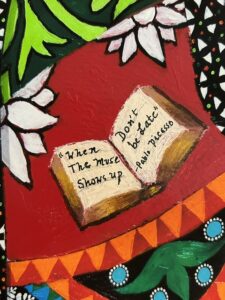
Artwork detail by Danielle Mailer.
“Always be writing, always be closing.” A simple idea that can bring profound results. Thanks, Judith. Congratulations on moving forward in your writing life.
Loved this!