Why I Love Riot Women
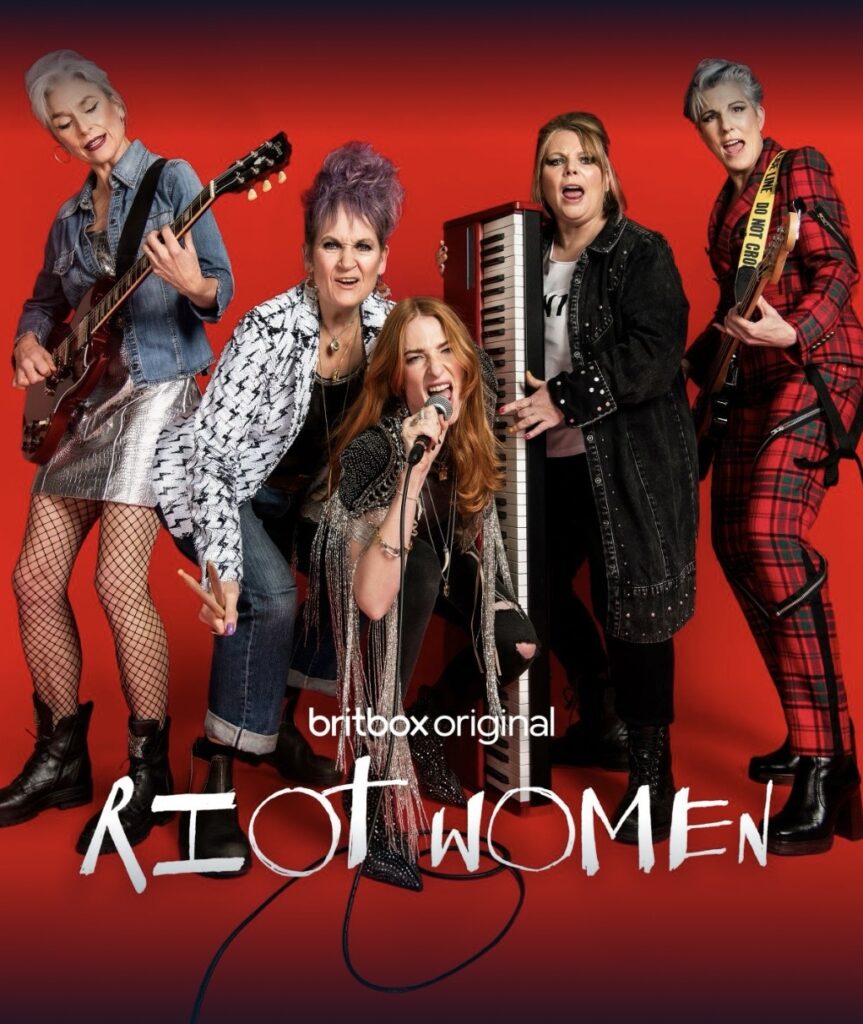
I love Sally Wainwright—so when a friend told me about Riot Women, a BBC show on BritBox, I had to watch.
Riot Women‘s demographic is my demographic. I admire Wainright’s raw, unflinching focus on women in their 50s and 60s, facing retirement and menopause, feeling invisible, and acting out. It’s about time! Wainright actually shows a door being closed in Beth’s face as she walks into work—later, at a music store, Beth has a chance to question the offender. “Did you not see me?” she asks. Calvin, the student, explains that he would have held the door if he’d seen her, but he was busy eyeing a young woman’s “assets.” Of course you were,” Beth says.
In the show, the women are overwhelmed and discouraged—they’re dealing with older parents, bothersome children, dead-end jobs, and failed relationships. One of them wants to start a band. Just temporarily, to enter a local charity show. A chance for something new, something to wake them up.
At first, they’re going to sing pop songs like ABBA’s, “Waterloo.” But Beth, who envisions the band as “punk-ish,” wants to sing about their lives. “And you thought The Clash were angry,” she says. The discussion between band members about what they should sing perfectly nails each character’s personality. They find a local singer, Kitty, who has “pipes”—and soon, Kitty and Beth are writing their own songs. Their lyrics normalize arguments with ex-husbands, periods, blood, menopause. Give me HRT. Give me HRT…. I’m seeing red, red, red, red, red, red… They’re gritty and loud—and having so much fun. Audiences love them. We love them.
It feels like in Riot Women, Wainright has hit her stride. She’s been building to this with her other female characters. The ones that come to mind are Gillian and Caroline from Last Tango in Halifax, a comedy-drama that first aired in 2012.
While this show focuses on the romance between Alan Buttershaw and Celia Dawson, who find each other after 60 years, it’s the contrasting daughters who really catch our attention. The differences are instantly evident—Alan’s Gillian’s a low-key sheep farmer who lives in rural Yorkshire; Celia’s Caroline is the Oxford-educated head of a posh school.
They start an unexpectedly candid friendship, each supporting her own parent, but also revealing their most intimate thoughts and feelings—about exes, boyfriends, fiancés, children, grandchildren, demons, love and death (even murder!). Nothing is off limits, which makes theirs a most refreshing friendship. Wainright’s women remind me of the characters in my own novel—Anne, Nell, and Libby, their intense friendships, self discovery, and the second chances that come their way.
I’d like to think that when Gillian and Caroline get older, they too might become members of a Riot Women band. Season Two of Riot Women is in the works—and so are the characters in my novel! Stay tuned for both!